Sunday, 15 April 2012

Narrative

My horror film opening sequence has a restricted narration, as it gives only minimal information about the narrative, all the while keeping the audience on edge. It doesn't let out too much detail, so that the audience can work it out for themselves. The character identification is quite subjective, as we only get to see what the characters see or do, without further knowledge of their thoughts.

Looking at Vladimir Propp's Theory of Narrative, in the opening sequence we would see 2 of the possible 7 characters: the villain and the victim.The villain, being the ruthless masked murderer, and the victim being the innocent woman who dies.

If we however looked at Tzvetan Todorov's Theory of Narrative, even in the opening sequence we can establish a few of the five stages that Todorov suggested are conventional in every film.

  • the equilibrium: when the victim is sitting at home, eating her snack and everything seems normal.
  • a disruption of the equilibrium: when she goes to take out the rubbish and we see the murderer hiding with a knife.
  • a recognition of the disruption: when the woman receives the first anonymous call and starts hearing strange noises.
Those are the tree out of five stages that can be recognised in this short film. Even though the opening sequence isn't a very long one, quite a few of the narrative structures can be applied to it, suggesting that it is good in a way that goes along with conventional Hollywood structures.

Since this is an opening sequence, the narrative had to show some elements of the actual film, but not give anything too important away, so the audience doesn't get boring and stop watching. That's why in this opening sequence we can see a single killing, with no idea who the killer might be or any idea about why he/she might be killing people. This should keep the audience interested enough in finding out, to keep them watching the rest of the movie.

This opening sequence tells a short story, as the order of events in it is in chronological order, with no flashbacks, flashforwards or dream sequences. It's a linear narrative.

Thursday, 12 January 2012

Changes

At the beginning of this course, I was paired up with someone but not too long into it, my partner had decided to drop out. Since he decided to do it quite early on in the lessons, it was quite fortunate because we hadn't done an awful lot of work by then. When we were still working together, we decided to do an opening sequence to a horror film. After he had dropped out, I decided to stick to the idea of an opening sequence to a horror film, thought I've changed the plot and the overall film idea.

Through most of the time during the course, I have been working on my own. Having gotten all the roles to myself, I thought of it as an advantage rather than something unfortunate. This way I had way more control over what I really wanted to do in my film, and I got to make all the choices.

I got my idea together, got my actors and had everything ready, but I realised this is a lot of work to be doing alone. My main actress, When I went to get a tape for my camera from my teacher, we told him we're both working on our own, and he suggested we pair up and do a film together instead. That seemed like a great idea, as we both needed another person to rely on, and we have already worked on a media project together before, in secondary school, so we knew it would work.

Sara, my new partner, already liked my film idea, so we decided to stick with that, not really making many changes to it. We split up the roles between us, me ending up being the producer and camerawoman, and her being director and editor.

Weeks 9, 10, 11 & 12

- progress of filming
- use of equipment
- what's going well?
- problems encountered
- schedule? on task? re-shooting?
- other relevant points

So far in our filming, things have been going good. We have chosen a final idea, our actresses and locations. For out film, we needed certain props, like a knife and a mask. Since in this project we are not allowed to use a real knife, we had to go out and search for a plastic, yet realistic looking knife, which we found in a costume shop. For our film we would also need blood. We decided to get a little creative with that, and instead of buying fake blood, we looked up recipes for fake blood online, bought the ingredients and decided to make it ourselves. We spent one day on all of this, putting us a little behind schedule as we were already supposed to start shooting that day, but it got too dark.

We decided to shoot the next day instead. When we started shooting, we had to think about which parts of the film we were going to shoot first, though knowing it didn't really matter since our whole film takes place in just one location. Since, when we started filming it was starting to get too dark already, we decided to shoot the parts inside the house first, and leave the shots from outside for another day.

We had a camera and tripad we had taken out of our college for the weekend. We were quite familiar with how a camera works, having done media before in secondary school and having to shoot a music video then. We got everything together and started planning out our shots, double checking to see which angles would work better for each scene. We had some trouble with the main actress getting serious for the role at first, but once she got herself together, it all went acording to plan.

The only real problem we have encountered so far, is time. We're finding it hard to find a good time to shoot, as we need it to be dark outside, but not dark enough for the camera to not be able to pick anything up. We seemed to have settled for 4 o'clock, but at that time it gets dark really quickly, so we always seem to miss the ideal time to shoot.

Weeks 7 & 8

Storyboard

Part 1

Part 2

Thursday, 3 November 2011

Weeks 5 & 6

Comparing texts

One of the examples I have studied for my coursework research is Scream. It is the main case study for my research, as I will be using it as an inspiration for my own movie. The genre of Scream is horror, as will be the genre of my product. The narrative of it, though it seems pretty simply, makes the audience think. Most people when thinking of the film, will see a masked killer trying to get to a girl. However, when you pay more attention to it, it becomes more than that. The narrative makes the audience think. It makes them want to figure out who the killer is, and what their motive might be for trying to get to this girl, killing many people along the way. The fact that there seem to be many suspects only makes the movie more interesting, as the audience seems to be even more eager to try and figure out the mysterious killer. The representation also seems to be quite simple – almost predictable. The main victim is a girl – this is quite common in most horror films. Women are usually portrayed as the weaker sex; the ones that get attacked and have to try and protect themselves from incoming danger. Overall, even though the movie might seem a bit predictable, it keeps the audience on edge throughout. Every step along the way, something new happens that makes the audience re-think their previous conclusion as to who the killer may be.

The second film I have studied for my coursework research is The Strangers. The genre of this film is also horror, and it seems, in context, pretty similar to Scream. The reason I have chosen texts that are quite similar to each other, is because I have a fixed idea of what I want to do for my product. The story in The Strangers is also about mask killers, although the circumstances are a bit different. A couple is at a summer house and is attacked by a group of three masked killers. The film itself doesn’t seem to have much of a plot, as it is just about the three people trying to kill the couple – there doesn’t seem to be any particular reason for why they are doing it – except the fact that ‘they were home.’ The representation in this film challenges the one in Scream as in here, two out of the three murderers are women, and one person in the couple is a male. This shows that it doesn’t always have to be just a woman victim, and that the murdered doesn’t always have to be a man, either. This film also keeps the audience on edge, but in a different way. It does still keep them guessing on who the killers actually are, and if there is a reason for why they’re doing what they’re doing, but also, in The Strangers, there are many moments which make the audience react – scream, jump, etc. 

Friday, 21 October 2011

Week 4

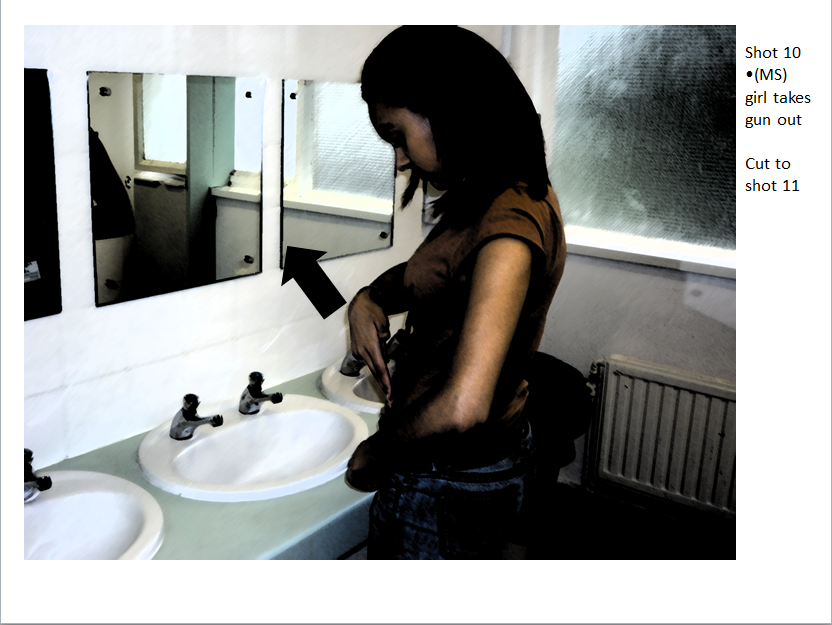
This week, we were given a 'practice' storyboard, for which we had to go out and shoot pictures.

'P' is for Psycho storyboard:


I think the process of doing this practice storyboard was ver effective, because it made me realise that sometimes you might not get all the props you need and you'd have to improvise. Also, it made me realise how to take certain shots to make sure they're the best for the scene.

Wednesday, 12 October 2011

Week 3


·         what is the storyboard and how is it used?
·         how will you create your own photo-storyboard? (power point/still photographs)
·         what is scripting? find examples of a script format and begin your own.

- A storyboard is a number of still shot photographs done in an order of how someone wants their movie to come out. It is a piece of work people follow when creating a film - a guideline, so to speak. A storyboard is kind of like a comic strip, showing what is going to happen in the film without the film actually being made yet.

- I will create my own photo-storyboard by taking still photographs of certain scenes in my film and i will put them together in a powerpoint presentation. I will include shot lengths, transitions, any edits, voiceovers, etc.

- Scripting is when you put your storyboard into words - instructions, per se. It's what's given to actors before a film; it includes stage directions, locations and what they're supposed to say. A short example of a script: